My latest JDSupra.com article can be found here.
My latest JDSupra.com article can be found here.
It was a great opportunity to speak in front of over 100 attendees at the Schwab National Conference in Scottsdale, AZ. The audience was primarily third party administrators and registered investment advisors.
The speech was about life after fee disclosure and some ideas that I had concerning how plan providers can compete in a post fee disclosure world.
I reiterated that even though plan providers got their fee disclosures out, now maybe an opportunity to review their fee disclosures for clarity and conciseness. The reason being that the Department of Labor is considering an additional guide of fee disclosures that plan providers may have to prepare, what I call “the guide to the guide of fee disclosures”. In addition to maintain a competitive advantage, a more concise and clear disclosures of fees can help with your clients because I am convinced that confusing disclosures or too many pages of disclosures will create confusions and confused clients, often become former clients.
In addition, there needs to be further communications from plan providers to their clients on what they actually do. My wife jokingly tells people that she still doesn’t know what I do for a living. At least, I think that’s a joke. Too often plan sponsors don’t understand what their plan providers do, so fee disclosures may make unwise plan provider changes based on price and not understanding that the savings in costs may also be accompanies by a decrease in quality and breadth of services. Plan providers needs to stress their value to their clients because when we talk about the fiduciary responsibility of only paying reasonable expenses, many plan sponsors forget the second half of the question “for the services provided.” Plan sponsors can pay more to get more and if they don’t understand that they get more in services, they maybe at a severe disadvantage if they make a change just on cost.
Once again, I am available for speaking engagements, far and wide including Bar Mitzvahs and First Communions (as long as those events are heavily attended by plan sponsors or plan professionals).
I am speaking at the Schwab National Conference in Scottsdale, Arizona on how third party administrators (TPAs)/recordkeepers can survive and thrive in a post-fee disclosure world. I am very thankful for the opportunity (as a very cheap plug here, I am happy to speak at conferences, continuing education courses, Bar Mitzvahs, and First Communions).
I’m not going to go over my slides here, but I think the most important thing for any plan provider to survive and thrive in this business now is about how to stand out among the crowd. What is your message? What is your value proposition?
I always talk about my frustrating experience at a certain semi-prestigious Long Island law firm (sorry, Lois). I do it partly to rub my success in their noses because they never had faith in me, but mostly because the way I market myself now is the way I wanted to market myself back there. I could have been a star there, I could have been a contender, I could have been somebody, instead of the bum I became.
When I was there, I wanted to use Twitter, I wanted to use Facebook, and I wanted to constantly post articles and blog messages. The bureaucracy of the law firm wouldn’t allow it. Social media was accused of the advertising committee of one of being barred by the legal advertising rules and I had a six-month wait on the publication of my articles because 3 partners had to approve my article before publication and the marketing department was bogged down in producing articles written by the law firm administrator that served no purpose other than his own. Since I’m constantly made comments about this abuse of resources, this law firm administrator’s article output has been whittled to nothing.
My message was to offer an ERISA practice that would be available for the small to medium sized plans that thought they couldn’t afford an ERISA attorney with fees on par with what the legal department at a TPA would charge, with the added benefit of an attorney-client relationship. My articles were going to try to help plan providers recruit and maintain clients, which would open a dialogue with these providers with the hopes I’d get clients through referrals by these providers. Since plan sponsors and plan providers were wary of the never ending possibility of being billed to death by the billable hour, I was going to charge a flat fee.
One of the ideas I had was that I was going to make a run at the clients of the old TPA I worked at. When I left that TPA, I was replaced by two attorneys and a paralegal (perhaps why a few TPAs have outsourced their legal department to my practice, cost effective is my middle name). So when my old TPA was charging $600 for the Section 415 amendment back in 2010, I was going to charge $300. Only problem is that the advertising committee wouldn’t let me say $300. For some reason, I had to say I’d do it in a cost effective manner. After contacting 750 of my old clients, I think I got 1 through this approach. 5 years later, I still think what would have happened had I been able to use $300 in the solicitation letter.
So enough of my life story, I’ll save it for the book. As any plan provider you need to find a message as to why anyone would hire you. Saying you’re cheaper or how the other provider isn’t going to cut it. If you are a financial advisor, the message is about offering a value, how your services will help a plan sponsor’s retirement plan, minimize their liability, and improve the retirement outlook of the plan’s participants. If you are a TPA, it’s how you facilitate the plan’s administration, eliminate the potential pitfalls of plan sponsor’s fiduciary liability, and plan design that can help a plan sponsor maximize contributions to certain employees while making the required minimum contributions to the rank and file.
Like ERISA attorneys, plan providers are a dime a dozen. You need to stand out among the crowd and it’s all about identifying a message that can help explain your services to potential clients and why you should be hired among the crowd. Hopefully, you’ll have better luck in getting your message out that I did those years ago at that law firm.
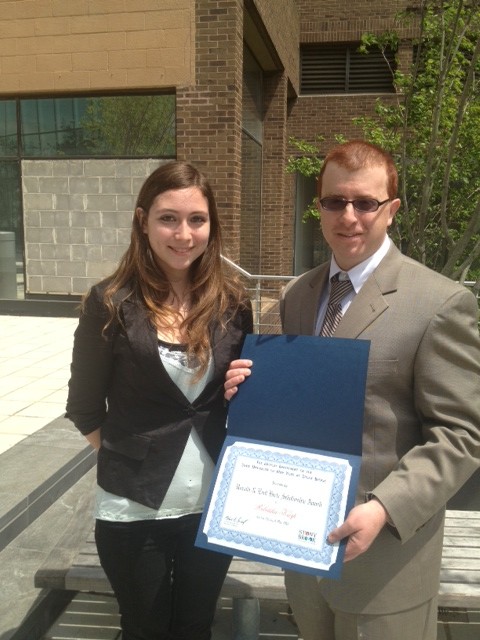
I am pleased and honored to announce that Rebekkah Karp, Stony Brook Class of 2016 is the winner of the inaugural Rozalia and Emil Berla Scholarship Fund.
As stated before, I started The Rozalia and Emil Berla Memorial Scholarship Fund at my alma mater, Stony Brook University. This scholarship is named for the two greatest people I ever knew, my maternal grandparents who both survived the Holocaust.
Many of you in the retirement plan industry have contributed already and you have my thanks. If you can spare just a couple of bucks towards this worthwhile scholarship, I would greatly appreciate it.
$1,000 isn’t much, but for a student attending such a great school, it’s a substantial step in paying tuition.
You can donate online through this link. All you need to do to make sure the scholarship gets the money is to type “Berla” in the fund designation.
You can mail any contributions to
Send to Jane McArthur c/o College of Arts & Sciences, E3320 Melville Library, Stony Brook, New York 11794-3391. The Berla Scholarship should be noted on the memo line of your donation.
All gifts will be noted with a tax receipt.
Again I appreciate any help in raising money for such a good cause.
When it comes to improving the 401(k) plan, you hear a laundry list of complaints as to why 401(k) plans suck. Yet the laundry lists never come up with any suggestions on how to improve them.
So I offer two suggestions on how to really improve 401(k) plans. They both will be extremely unpopular and folks in the industry will say how either of these proposals will be gloom and doom for 401(k) plans. I may not be necessarily 100% in support of one of these draconian options (actually only one is), but the fact is that a shock to the system will improve the system.
So my gloom and doom choices would be:
Both proposals have absolutely no shot of ever happening because the industry is inundated with providers who would lose out if one of these proposals came out (yes, the mutual fund companies).
While everyone is fee obsessed, the main trouble regarding 401(k) plans is that with the advent of daily valued, participant directed plans is that it required the person least sophisticated to make investment decisions (the plan participant). It also gave the plan sponsor some false security that as long as participant directed their investments, they had unlimited liability protection under ERISA Section 404(c).
While these proposals will never come into being, at least I have offered something to improve 401(k) plans. Either requiring affordable investment advice or getting plan participants out of the investment decision making process will help try to alleviate the biggest problem affecting retirement plans is that participants don’t have the background to make investment decisions, which only exacerbates the problems affecting 401(k) plans.
What is often heralded as the next big thing often turns out to be a dud. I’m still waiting for Tim Leary to be the next Tom Seaver for my New York Mets.
Well for many in the retirement plan business, the next big thing may be ERISA §3(16) fiduciary services, where someone (probably a third party administrator (TPA) or an affiliate) assumes the responsibility of administrator from the plan sponsor.
The “Plan Administrator” of a qualified retirement plan is defined in section 3(16) of ERISA. The Plan Administrator should not be confused with a “Pension Administrator” or a TPA.
Unlike the TPA, the Plan Administrator actually has the following primary responsibilities:
◦ Ensures all filings with the federal government (form 5500, etc.) are timely made;
◦ Makes important disclosures to plan participants;
◦ Hires plan service providers if no other fiduciary has that responsibility; and
◦ Fulfills other responsibilities as set forth in plan documents.
A TPA is delegated these responsibilities, but the plan sponsor bears the responsibility. The §3(16) fiduciary/administrator assumes that responsibility, as the plan sponsor outsources it.
So this is a great space for TPAs to be in just like §3(38) fiduciary services are a great space for registered investment advisors because it’s just a notch (but a lot more liability) than what they are currently doing.
Again, it’s not a right fit for every TPA and not the right fit for every plan sponsor client (especially those that handle their role as plan sponsor well).
Is it the next big thing? I think it’s a great business because a year later, open multiple employer plans are pretty much dead and more plan sponsors want the opportunity to delegate some or most of their duties as plan fiduciary.
§3(16) administration is just another form of what is getting to be known as “401(k) outsourcing”.
I think it’s a growth spot for TPAs, especially for everyone who feels that fee disclosure is putting the squeeze on fees and profit margins
My good friends at DALBAR offers certification of those that want to be §3(16) administrators, I’m sure CEFEX probably does as well.
If you are a TPA interested in offering a §3(16) service, feel free to call (agreements for the service are at a flat fee). Even if you are not interested in offering yourself, but interested in partnering up with a non-TPA who offers it, give me a call as well. Sorry for the cheap plugs.
My latest JDSupra.com article can be found here.
My latest newsletter geared towards financial advisors can be found here.
My latest JDSupra.com article can be found here.
Before I had kids, I played golf. I took weekly golf lessons from a guy named Kenny. When it came to golf clubs, Kenny said that gold clubs were merely tools. It all depended on how you used them. My Callaway clubs that are collecting dust in the garage weren’t going to make me break 100, what I did with them would. Clubs wouldn’t make me slice in the woods, how I used them would.
Thanks to Frontline and a column by Thomas Friedman from the New York Times, a lot of blame about retirement is focused on 401(k) plans. 401(k) plans didn’t help kill off pension plans, employers who were saving money and a change in the Internal Revenue Code limiting compensation and benefits did. Again, like golf clubs, 401(k) plans are tools. The retirement gamble or jackpot is dependent on how plan sponsors and plan participants use their 401(k) plan. A vigilant plan sponsor concerned about the retirement outcome of their employees and concerned about limiting their liability as plan fiduciaries are going to have a better 401(k) plan and retirement outcome than those who never benchmarked fees and haven’t reviewed their fund lineup in 10 years.
A 401(k) plan is a tool, nothing more and nothing less. There is no evil in a 401(k) plan; just neglectful plan sponsors, participants, and providers that make a 401(k) plan look like a losing gamble.